Industrial gearbox repair begins by identifying what failed, why it failed, and which components remain suitable for service. A useful repair restores the required function and addresses the conditions that caused damage. Replacing a leaking seal or noisy bearing without investigating shaft condition, lubrication, load, and alignment can leave the original problem in place.
Use this service resource to organize a repair evaluation for a production gearbox, speed reducer, or connected drive. It covers the general repair decision. For a complete overhaul, see gearbox rebuilding; for a stopped production line, use emergency gearbox repair.
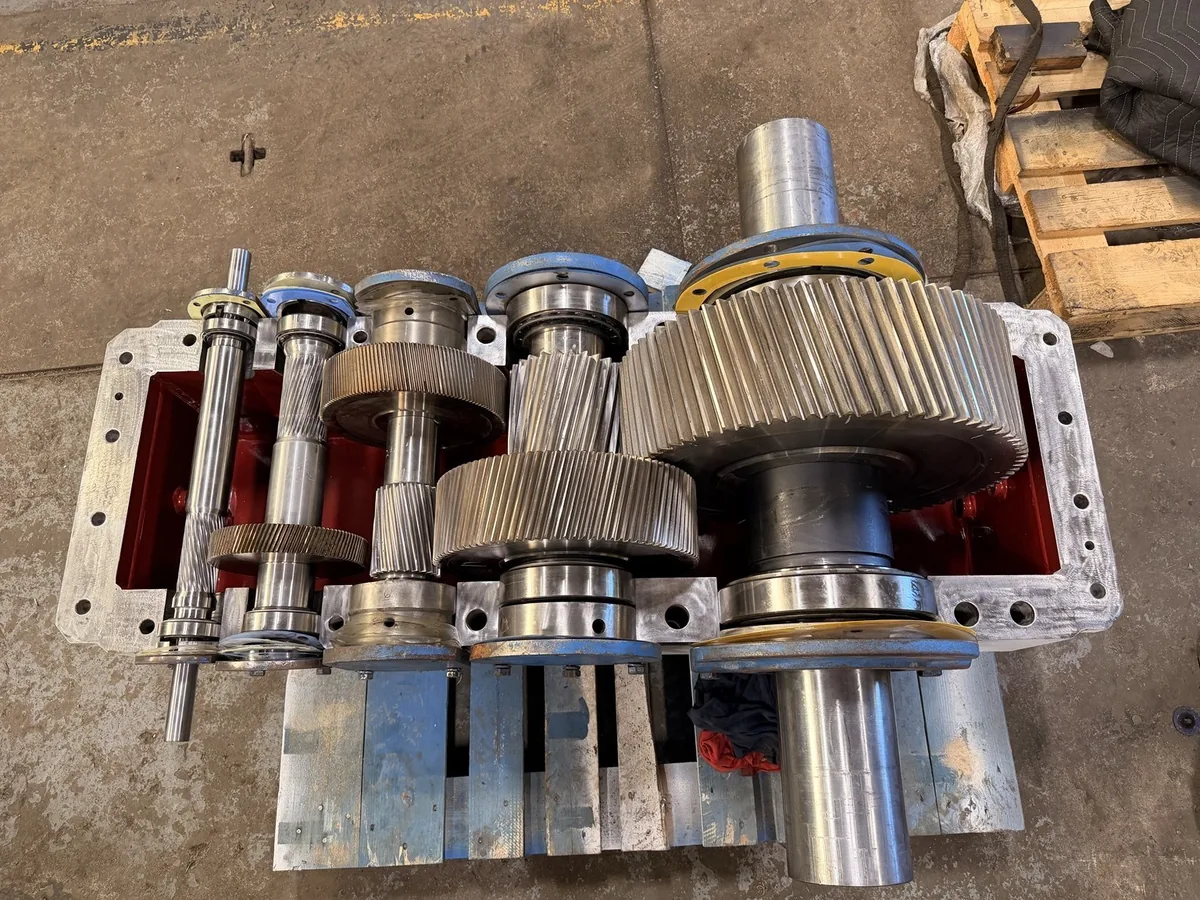
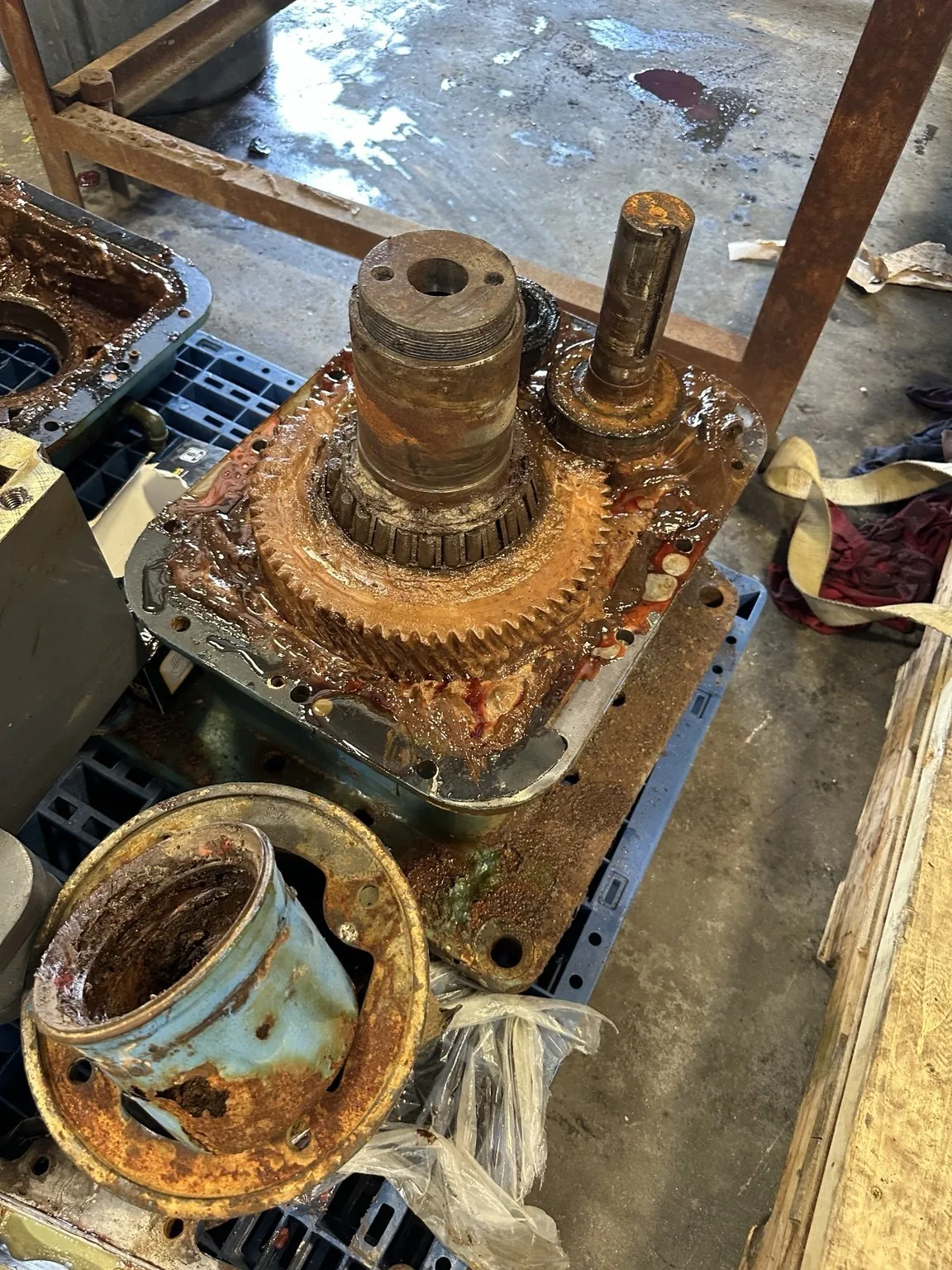
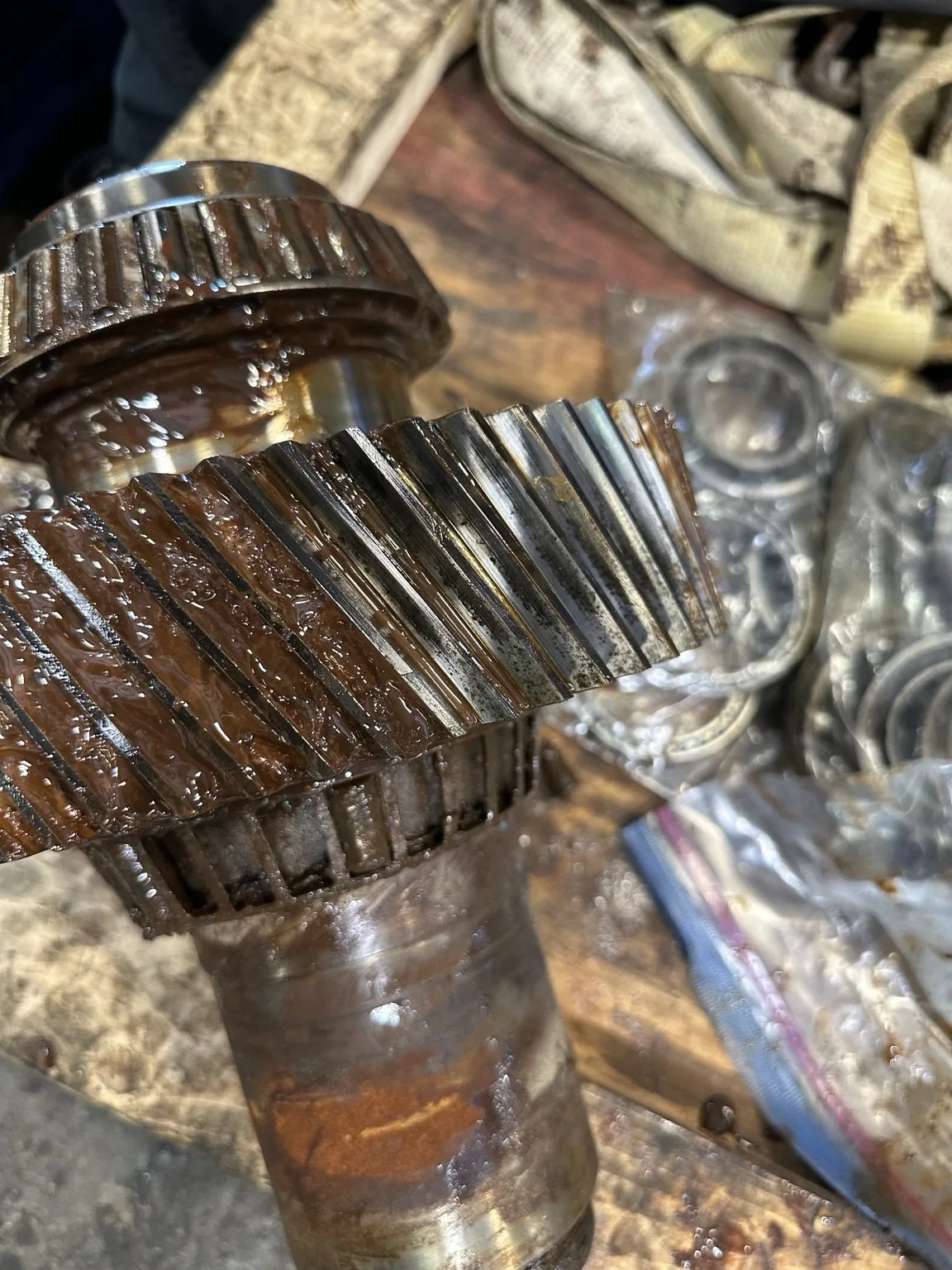
Opened gearbox and component views
Selected photographs from the Gear Services photo guide. These views do not establish a complete repair history or measured results.
What does industrial gearbox repair include?
A repair scope can include inspection, bearing and seal replacement, shaft restoration, gear replacement, housing evaluation, lubrication-system work, and assembly checks. The actual work depends on the gearbox design and measured condition. A repair is not automatically a full rebuild, and neither term establishes a test standard or warranty by itself.
The starting objective should be concrete: restore reliable operation at an identified speed, torque, mounting position, and duty cycle. Record whether production requirements have changed. A gearbox originally selected for intermittent operation may need a different engineering assessment after a line begins running continuously or handling a heavier product.
Define the equipment boundary
Identify whether the evaluation includes the motor, coupling, brake, backstop, torque arm, cooling circuit, or driven machine. Noise and vibration travel through connected structures. A sound heard at the housing does not prove that the gears are the source. Defining the boundary helps prevent separate contractors from overlooking the interface between their equipment.
Separate inspection from repair authorization
An initial examination establishes what can be observed without complete disassembly. Internal damage, hidden cracks, and damaged fits may only become apparent after cleaning and measurement. Agree on the evaluation scope first, then approve a repair proposal that identifies retained parts, replacements, restoration work, exclusions, and acceptance checks.
Common gearbox failure symptoms and what they suggest
New noise, knocking, or vibration
An unfamiliar sound can accompany gear damage, rolling-element bearing distress, looseness, coupling wear, or a change in process load. Record when it occurs: startup, acceleration, steady production, reversal, or coastdown. A vibration specialist can compare frequency information with shaft speeds and gear tooth counts, but a single overall reading rarely identifies a specific failed part.
Avoid repeatedly restarting a damaged machine just to obtain a recording. Use existing monitoring records and observations collected from approved safe locations. Sudden severe vibration, impact noise, or a protective trip requires the site's shutdown and investigation process, not continued operation to see whether the symptom disappears.
Increasing temperature
Temperature rise can be associated with unsuitable lubricant, incorrect oil level, restricted cooling, contamination, friction, or increased load. Compare readings taken at the same location under similar operating conditions. Ambient temperature, speed, and time since startup matter. A housing surface measurement is not interchangeable with an oil-sump or bearing sensor reading.
There is no single safe temperature limit for every industrial gearbox. The applicable manual, lubricant specification, seal materials, and protection settings govern the assessment. If a temperature alarm occurs, investigate the actual conditions and sensor performance rather than simply increasing the alarm threshold.
Oil leakage or changing oil appearance
Leakage may involve a worn seal, a damaged shaft surface, a blocked breather, an incorrect fill level, or housing-joint problems. Trace the path before deciding which part to replace. Oil running down a housing can make an upper leak appear to originate at a lower shaft seal.
Cloudiness, foam, discoloration, and debris are useful observations, but appearance alone is not a laboratory result. Record recent oil additions, lubricant changes, washdown exposure, and maintenance work. Take samples using the established sampling method so results can be compared with previous findings and interpreted in context.
Lost motion or unreliable output
Unexpected movement at a coupling or output shaft can originate in splines, keys, gear meshes, bearings, or the driven machine. Backlash is part of many gear designs; excessive or changing movement requires measurement against the relevant specification. Do not tighten or shim an assembly merely to eliminate all visible movement.
How to diagnose the problem before disassembly
Start with an equipment brief: manufacturer, model, serial number, ratio, input speed, motor power, mounting position, and application. Add a description of the event in chronological order. “The oil alarm occurred before the noise” is more useful than “the gearbox is bad,” because the sequence can help distinguish initiating damage from secondary damage.
Collect operating hours if known, normal load range, recent overloads, lubricant identification, oil-analysis reports, and previous repairs. Note process changes such as a new feed material, higher throughput, altered control settings, or frequent starts. Keep observations separate from conclusions so the inspection team does not inherit an unsupported diagnosis.
Qualified personnel should apply the site's isolation and stored-energy procedures before physical inspection. Connected equipment can move after electrical power is removed. Internal inspection, shaft movement checks, and coupling removal need an equipment-specific method and appropriate lifting support.
Examine the surrounding installation
Check documented alignment, mounting condition, foundation integrity, and coupling configuration. A gearbox may be correctly assembled but overloaded by an unsuitable connection. Identify pipe loads, belt tension, driven-equipment binding, or structural movement where those conditions apply. The repair plan should assign responsibility for correcting external causes before the unit returns.
Use evidence together
Oil analysis, vibration trends, temperature history, and dimensional inspection answer different questions. Debris indicates material loss but may not identify the component. Vibration can help locate a developing issue but may be influenced by machine structure. Dimensions establish whether a fit is acceptable but do not reconstruct the entire operating history. The strongest diagnosis explains how these findings agree, and where uncertainty remains.
The repair process from intake to return
1. Record the as-received condition
Photograph the unit, identify its ports and accessories, and document shipping condition. Preserve useful evidence before cleaning removes it. Record missing guards, plugs, brackets, and loose components without assuming they caused the operating failure. Distinguish transport damage from damage that occurred in service.
2. Disassemble and retain component identity
A controlled teardown records bearing positions, shim locations, gear orientation, and assembly relationships. Components that look interchangeable may have different histories or adjustment requirements. Keep the relationship between each observation and its original location so the final report can describe a credible failure path.
3. Clean, inspect, and measure
Inspect gear teeth, shafts, bearing seats, housing bores, threads, keyways, and sealing surfaces. Suitable crack-detection methods may be needed where material, geometry, or visible indications justify them. Measure against the applicable drawing or engineering acceptance basis. A component should not be declared reusable solely because it looks clean.
4. Approve the repair scope
The proposal should explain which damage is repairable, what requires replacement, and what remains uncertain. Identify any outsourced processes and their schedule dependencies. If replacement gears are needed, custom gear manufacturing involves a separate technical definition, not simply copying the outside dimensions of the damaged part.
5. Reassemble to documented requirements
Assembly includes the correct bearing arrangement, applicable fits, fastener requirements, seal orientation, lubrication provisions, and specified adjustments. Backlash, bearing settings, and contact assessment depend on the design. Universal values are inappropriate across different gearbox families. Record the reference used for each acceptance decision.
6. Verify and hand over
Agree in advance which static checks and running checks are included. A no-load run may reveal leakage, unusual noise, or assembly concerns, but it does not demonstrate full-load capacity under the plant's operating conditions. The handover should describe test conditions, observations, limitations, installation requirements, and unresolved recommendations.
Repair versus replacement: compare the complete outcome
Repair is worth evaluating when the housing and core geometry remain usable, replacement parts can be obtained or engineered, and the restored unit suits the application. Preserving existing mounting arrangements can reduce changes to foundations, couplings, guards, and connected equipment. Those avoided changes belong in the comparison alongside the workshop quotation.
Replacement deserves closer consideration when structural damage is extensive, repeat failures reveal an unsuitable duty, or obtaining acceptable parts introduces unacceptable uncertainty. An available replacement may still require interface changes and commissioning work. Compare installed options rather than a bare replacement price against a complete repair package.
Use three questions: Can the unit be restored to an acceptable technical condition? Can it be ready within the required outage? Does the total cost and residual risk make sense over the expected service period? A low quote cannot compensate for a repair that does not address the actual duty.
A practical comparison example
Suppose an inspection finds local bearing damage with acceptable gears and housing fits. A limited repair may be reasonable if the lubrication problem is corrected. If the same inspection finds multiple damaged gears, distorted bores, and an increased process load, a complete rebuild or replacement assessment becomes more important. These are decision examples, not reported customer projects or promised outcomes.
Industries and applications
Industrial reducers appear in conveyors, mixers, bulk-material handling, processing lines, mills, and other driven equipment. The industry name alone does not define the repair requirements. A conveyor's start-and-stop duty, a mixer's changing resistance, and a mill's shock loading can produce different inspection priorities even when the gearboxes look similar.
Food, chemical, wastewater, mineral-processing, and general manufacturing environments can also impose different contamination, lubricant, corrosion, and access requirements. Identify the actual exposure and any plant-specific material restrictions. Application examples describe where gearbox evaluation may be relevant; compatibility and service scope must be confirmed for the individual unit.
Specialized designs merit their own assessment. See extruder gearbox repair for thrust and screw-drive issues, cooling tower gearbox repair for fan-drive conditions, and planetary gearbox repair for load-sharing gearsets. Electrical or hydraulic symptoms may instead lead to industrial motor and pump repair.
Why consider Industrial Gearbox Service?
Industrial Gearbox Service states that its team brings 50 years of experience in industrial gearbox service and repair. This is a company-provided statement. Experience should support a clear explanation of the findings, the proposed work, and the conditions needed for a successful return to service.
When discussing your project, request a scope that connects each recommended action to evidence. Ask which measurements support component reuse, what caused the damage, and what the plant must correct. These questions help turn a broad service description into a repair decision your maintenance and purchasing teams can review together.
The appropriate reason to hire a repair provider is fit for the actual equipment and project requirements. Confirm model coverage, handling capacity, inspection methods, test availability, schedule, and written commercial terms. This page does not establish manufacturer authorization, certifications, emergency availability, or a warranty period.
Prepare a useful repair inquiry
Include clear nameplate photographs, overall equipment views, failure timing, operating duty, and any existing condition-monitoring reports. Identify the required return date and explain whether it is a planned outage or an unplanned stop. State whether removal is complete and whether the receiving workshop needs to assess attached equipment.
Use the repair brief to organize these details. The current preview downloads the brief locally; it does not send an inquiry. For transport preparation and intake coordination, consult the shipping guide. A complete brief improves the first conversation without requiring the plant to diagnose internal damage before inspection.
Review a proposed repair before approving it
Ask the provider to connect three things in the proposal: the observed damage, the recommended action, and the evidence that will show the action is complete. For a worn bearing seat, that might mean a recorded measurement, a specified restoration or replacement, and a final dimensional check. For an oil-supply issue, it might mean identifying the restriction, correcting the affected circuit, and documenting the required functional check. This structure makes a proposal easier to assess than an unexplained list of replacement parts.
Check the boundaries of the price. Cleaning a gearbox does not necessarily include cleaning an external oil reservoir. Replacing a shaft seal does not necessarily include restoring its running surface. Testing the gearbox does not necessarily include testing the motor or connected machine. These are questions to resolve in the written scope, not reasons to assume work has been omitted deliberately.
Finally, compare the proposed return condition with the plant's installation plan. Identify who supplies the operating lubricant, who performs alignment, and who accepts the first production run. Request instructions for any special storage or shipping condition. A repair can be technically complete at dispatch while the plant still has important work before startup. Keeping that distinction visible helps purchasing compare quotations fairly and helps maintenance prepare the receiving team.
Frequently asked questions
What is the difference between a gearbox fault and a gearbox failure?
A fault is an abnormal condition that may still permit operation; a failure means the unit no longer meets a required function. Continued operation depends on risk, protection settings, and the equipment's instructions, not terminology alone.
Can a gearbox be repaired without replacing its gears?
Yes, when inspection shows the gears remain acceptable and the damage is confined elsewhere. Bearings, seals, or external systems may need attention. Reuse should follow measured condition and the applicable acceptance criteria.
Does a leaking output seal mean the whole gearbox needs rebuilding?
Not necessarily. Investigate the seal, shaft surface, bearing support, venting, and fill level. A localized leak and a gearbox with widespread internal wear require different scopes.
Why does the gearbox become louder under load?
Load changes forces through gears, bearings, couplings, and the machine structure. Increased noise can have several causes. Compare its timing with load and speed records before assigning the source.
Can oil analysis identify the exact damaged gear?
Usually not by itself. Results can indicate wear, contamination, or lubricant changes, but locating the damaged part generally requires additional evidence such as inspection, vibration analysis, and component material information.
Should I add thicker oil to quiet a reducer?
Do not change viscosity to mask noise. Lubricant selection must suit the manufacturer's requirements and operating conditions. A change can affect lubrication delivery, temperature, and component protection.
Is every amount of backlash a defect?
No. Many gear meshes require clearance. The relevant question is whether measured backlash and its variation meet the design requirement. An arbitrary zero-clearance adjustment can create problems.
Can housing bearing bores be restored?
Some can, subject to material, damage extent, alignment, and an approved restoration method. The repaired bore must meet dimensional and geometric requirements; cosmetic cleanup is not enough.
What information matters if the nameplate is unreadable?
Provide photographs, machine identification, available drawings, shaft dimensions, mounting arrangement, and operating records. These can support identification, but an estimated ratio or rating should remain unverified until established.
Can an input coupling cause gearbox vibration?
Yes. Coupling condition, alignment, balance, and installation can influence the drive. Inspect the complete connection instead of assuming every vibration measured on the housing originates internally.
Why would a repaired gearbox fail again quickly?
An unresolved external load, contamination source, lubrication issue, installation error, or incomplete repair scope can contribute. Repeated failure requires investigation of the earlier work and the surrounding system.
Is surface temperature enough to approve continued operation?
No. Surface readings vary with location and conditions and do not directly establish internal bearing temperature. Use the equipment's limits and other condition information within the site's operating procedures.
Can a gearbox ratio be changed during repair?
A ratio change is an engineering modification. It affects speed, torque relationships, geometry, and potentially thermal performance. Do not treat it as a routine repair substitution.
What should a teardown report contain?
Unit identification, as-received observations, component findings, relevant measurements, photographs, and recommendations. It should distinguish confirmed damage from suspected causes and explain the basis for reuse or replacement.
Does a no-load test prove production readiness?
It provides limited evidence under the stated test conditions. Full production loads, connected-equipment effects, and plant installation conditions may remain untested. Define commissioning checks separately.
Can a damaged keyway be repaired?
Possibly, after assessing shaft integrity, fit, loading, and the proposed method. A repair must restore an acceptable connection without creating an unsupported stress concentration or dimensional compromise.
Should a spare gearbox be inspected before installation?
Yes. Check its identity, preservation condition, compatibility, and readiness using the applicable instructions. A stored spare should not be assumed serviceable solely because it has not recently operated.
How is the final repair price established?
The scope depends on findings, parts, restoration work, testing, and logistics. Ask whether the initial figure is an estimate or a firm quotation and what findings could change it.
What records should be kept after installation?
Retain the repair report, lubricant specification, alignment records, commissioning observations, and baseline monitoring readings. These records help future maintenance distinguish normal behavior from a developing change.
Where should I start if I cannot identify the symptom?
Describe what changed in production, when it started, and any alarms or maintenance events. Provide equipment identification and existing records. A useful evaluation can begin without a preselected diagnosis.
Brand-specific gear drive services and identification
Gearbox repairs, gear drive repair, and gear reconditioning requests need the same starting evidence: exact equipment identification, operating context, and a defined fault. Use the gearbox brand guides for make-specific planning and parts questions. For a full overhaul, compare gearbox rebuild services against the inspected condition and replacement options.
When comparing gearbox specialists or gearbox rebuilders, ask about the actual unit, inspection scope, acceptance checks, and documented repair records. If you are searching for gearbox repairs near you, confirm the workshop location, receiving arrangements, and any travel charges before booking transport.
Compare inspection reports and testing scope
A useful gearbox repair proposal should make five decisions visible: what failed, which components remain usable, what work is proposed, how the result will be checked, and what the facility must do when the unit returns. Request dated photographs and clearly identified findings rather than accepting a general description of a complete overhaul.
Make testing requirements explicit
Ask whether the quoted scope includes a visual inspection, dimensional checks, nondestructive examination where appropriate, an unloaded run, or a separately specified load test. These checks answer different questions. Record the proposed operating conditions, measurements, acceptance criteria, and limitations in the scope; do not treat every mention of testing as equivalent.
Include obsolete parts and field responsibilities
For an obsolete component, establish whether original drawings or approved specifications are available and who must approve any replacement design. For field work, identify responsibility for safe isolation, removal, lifting, transport, alignment, and commissioning. Ask which activities are included in the estimate and which need separate arrangements.
What manufacturer references support the assessment?
NORD’s service FAQ separates oil leakage, temperature, noise, and vibration checks. Its manuals library provides model-specific operating documentation. SKF’s bearing wear research explains the role of lubrication and contamination. These references inform diagnosis; they do not establish manufacturer affiliation or replace the instructions for your unit.