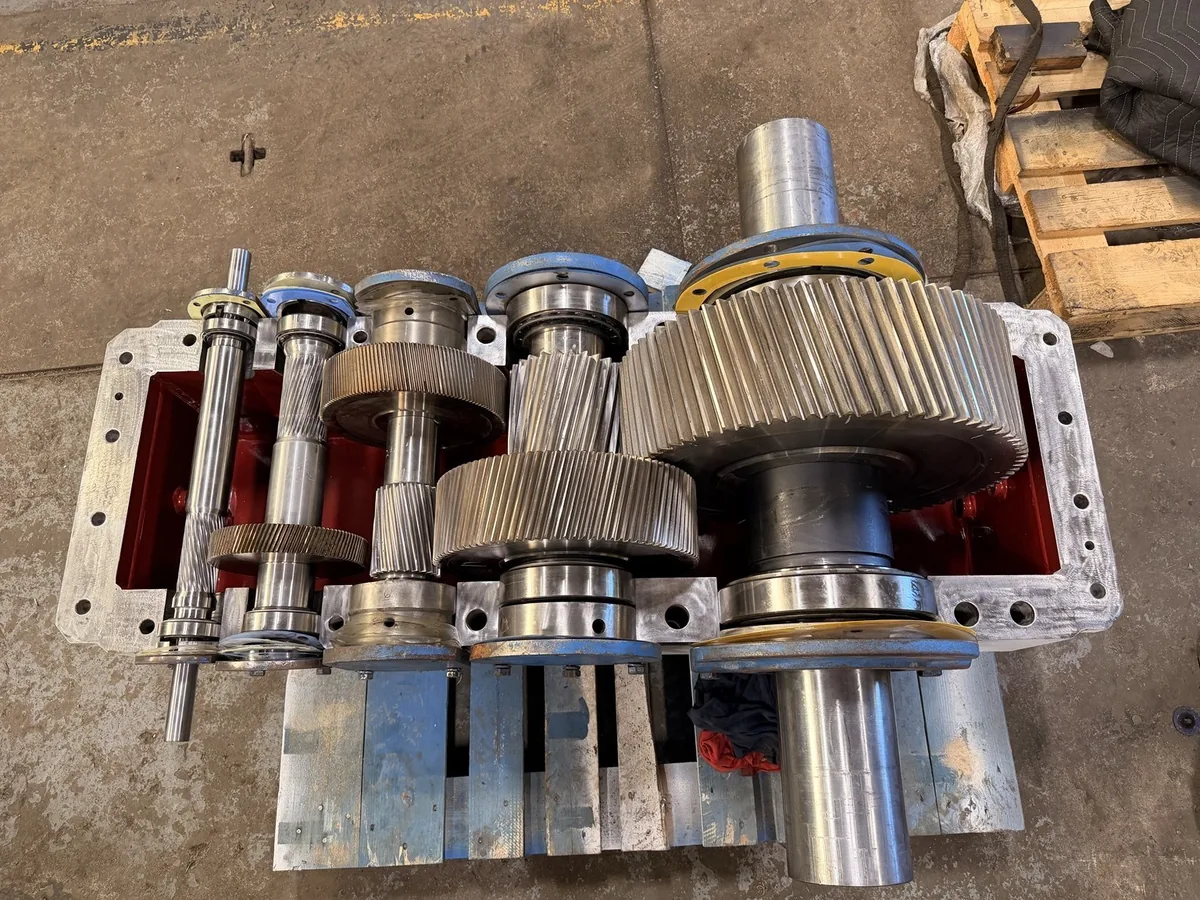
Emergency gearbox repair is the evaluation and restoration of a failed or unsafe drive when an unplanned outage makes time critical. The first decision is how to secure the equipment and preserve evidence. The next is whether a targeted repair, full rebuild, available spare, or replacement offers the most credible route back to production.
Urgency does not establish the damage extent or make every repair practical. A useful emergency plan identifies the equipment, separates confirmed facts from assumptions, and gives maintenance, operations, purchasing, and the repair provider a shared sequence of decisions. Availability, response time, transport, and completion dates must be confirmed for the individual job.
What should you do immediately after a gearbox failure?
Follow the plant's shutdown, isolation, and incident procedures. Notify the responsible maintenance and operations personnel. Do not repeatedly reset a trip or restart a drive with severe noise, smoke, loss of lubrication, unexpected movement, or suspected internal breakage just to confirm that the fault remains.
Qualified personnel should control electrical, mechanical, hydraulic, pneumatic, thermal, and gravitational energy as applicable. A stopped motor does not mean a connected conveyor, suspended load, pressurized system, or rotating fan is safe. Access, removal, and inspection need the machine-specific isolation method and suitable lifting arrangements.
Preserve the sequence of events
Save existing alarms, drive fault codes, trend data, and operator observations before they are overwritten. Record the time of the first abnormal symptom, the operating speed and load, and what happened next. A lubrication alarm followed by vibration suggests a different investigation from a jam followed by an overload trip.
Photograph visible leakage, damaged connections, and the nameplate where this can be done safely. Avoid cleaning, draining, or dismantling solely to make the equipment look ready for repair. Those actions can remove evidence. Coordinate necessary preservation and handling work with the people conducting the investigation.
Establish a single equipment status
Tell everyone whether the machine is stopped, isolated, awaiting inspection, ready for removal, or approved for a specific next step. Do not use “ready” to describe several different states. A gearbox can be ready for collection while still lacking an approved repair scope. Precise status prevents unauthorized restarts and missed handoffs.
Which symptoms make an outage urgent?
Sudden impact noise or loss of output
A sharp mechanical event followed by loss of output can involve a broken coupling, failed key, gear damage, or another interruption in the drive path. External inspection may locate an obvious defect, but it does not prove that the gearbox escaped secondary damage. Document the event and assess connected components before deciding on a limited replacement.
Fast temperature rise or lubrication failure
Loss of oil circulation, a major leak, or an abnormal temperature trend can threaten several components at once. Review existing pressure, flow, level, and temperature indications within the manufacturer's operating requirements. The protection system may detect a real mechanical issue or a sensor fault; neither possibility justifies bypassing it without the approved investigation.
Rapidly worsening vibration
A new severe vibration can indicate damage or looseness somewhere in the drive train. The immediate decision depends on the machine's protections and site risk assessment. An emergency page cannot supply a universal vibration threshold because measurement method, speed, mounting, and equipment design change what a reading means.
Contamination following a plant incident
Flooding, washdown intrusion, process leakage, or a damaged lubrication circuit can create an emergency even before a gearbox becomes noisy. Identify the contaminant, exposure duration, and whether the unit ran afterward. Handling requirements may also change if process chemicals entered the oil or housing.
The information that speeds up initial assessment
Send the manufacturer, model, serial number, ratio, and clear nameplate photographs. Include the application, motor power, input speed, mounting position, and the symptom timeline. If a field is unknown, label it unknown. An invented ratio or weight can create a larger delay than acknowledging missing information.
Describe the production consequence and required return date. Explain whether another line can carry the load, a spare is available, or an outage window can be extended. These facts help compare alternatives; they should not pressure an inspector into declaring a damaged component acceptable.
Separate equipment readiness from commercial readiness
Identify who can approve inspection, additional work, freight, and replacement parts. Include a backup contact and any purchase-order requirements. Emergency jobs often wait because a technical recommendation has reached someone who cannot authorize it. Set an approval route before the teardown report arrives.
Identify access and transport constraints
State the lifting access, loading facilities, approximate dimensions, confirmed weight if available, and whether the unit is still installed. Report contamination and attached accessories. Coordinate the actual receiving location before dispatch. Sending a heavy assembly to an unprepared destination can erase any time saved by expedited transport.
How an expedited repair assessment should work
Intake and damage triage
The first workshop milestone is identification and condition assessment, not an automatic promise of a finished gearbox. As-received photographs and inspection notes establish the starting point. The provider should explain when a meaningful scope decision can be made and what information might still be missing after the first examination.
Triage separates a potentially limited repair from a unit requiring extensive disassembly or engineering. An external seal problem, a damaged coupling connection, and internal gear breakage have very different dependencies. The schedule should reflect the actual path rather than assigning the same rush duration to every gearbox.
Controlled teardown and evidence review
Document internal component positions, damage patterns, debris, and lubrication condition. A broken part may be the consequence of another defect. For example, bearing damage can disturb a gear mesh, while a gear fracture can distribute debris into otherwise serviceable bearings. The proposed scope must account for the sequence that the evidence supports.
The first decision gate
Ask for a concise finding: what is damaged, what can be retained, what requires replacement, and what cannot yet be judged. Pair that finding with the next dependency. The decision might be to authorize a limited repair, obtain a gear manufacturing proposal, evaluate a replacement, or stop work pending additional measurements.
A preliminary schedule should identify assumptions explicitly. “Subject to bearing availability” describes a risk; it is not a confirmed dispatch date. Request an updated forecast when the dependency is resolved, with the effect on installation and restart made visible to the plant team.
Repair, rebuild, spare, or replacement during an emergency
A targeted repair can be attractive when damage is contained, suitable parts are available, and the remaining assembly meets acceptance requirements. The work still needs checks that address contamination and the initiating cause. A quick bearing change is not a complete solution if damaged fits or an unresolved lubrication fault will undermine it.
A gearbox rebuild may be more appropriate when wear or contamination is widespread. Rebuilding adds steps but can avoid returning a partially assessed assembly to a critical duty. The relevant comparison is credible time to reliable operation, not the smallest number of workshop hours.
Evaluate an available spare carefully
Verify ratio, rotation, shaft arrangement, mounting, lubrication configuration, load suitability, and preservation condition. Similar appearance does not establish interchangeability. A spare can also require coupling changes, alignment, guard adjustments, and commissioning. Include those tasks in the outage forecast before calling the spare the fastest option.
Evaluate replacement as an installed solution
Replacement availability is only one part of the schedule. Foundation changes, electrical work, controls, adapters, and driven-equipment interfaces may affect return to service. Ask the responsible engineering team to confirm compatibility and any rating differences. Do not assume an increased motor rating makes a replacement gearbox suitable.
Treat temporary measures as engineered exceptions
A temporary arrangement needs a defined duty, acceptance basis, operating limits, monitoring plan, responsible approver, and exit date. Improvised shimming, bypassed protection, or unverified substitutions can create a second failure. Emergency repair should make uncertainty visible, not disguise it as a short-term fix.
What actually controls emergency turnaround?
Inspection access, component availability, gear manufacture, heat treatment, machining, housing restoration, assembly, and testing can each determine the finish date. Some tasks overlap; others cannot begin until earlier findings are approved. A realistic schedule identifies the critical dependency and explains how it will be resolved.
Where custom gear manufacturing is required, dimensional definition and material requirements remain necessary. Expediting can prioritize resources, but it cannot make an unidentified tooth form or unknown heat-treatment requirement disappear. Ask which technical decisions are complete and which still require engineering review.
Keep updates tied to milestones
Useful updates report a completed inspection, approved scope, confirmed part arrival, finished machining, assembly readiness, or test result. “Working on it” does not help a plant plan labor or transport. Agree on update frequency and escalation contacts that match the outage, without requiring a workshop to invent certainty between milestones.
Distinguish dispatch from production restart
The return journey, unloading, installation, lubricant preparation, alignment, guarding, controls checks, and commissioning all take time. Give the plant's return-to-service team the workshop forecast early enough to prepare. A finished repair sitting on a loading dock is not restored production.
Emergency repair applications
An urgent gearbox outage can affect conveyors, mixers, crushers, extrusion lines, cooling equipment, or other production assets. Each application changes the consequence of delay and the removal constraints. A cooling tower fan can involve elevated access and wind-driven rotation; a process mixer can involve material containment and cleaning; an extruder can involve stored heat and process pressure.
Use the specialist resources for extruder gearbox repair, cooling tower gearbox repair, and planetary gearbox repair when those designs are involved. Emergency coordination belongs here, while equipment-specific inspection requirements belong in the relevant service scope.
Why consider Industrial Gearbox Service for an urgent problem?
Industrial Gearbox Service states that its team brings 50 years of experience in industrial gearbox service and repair. That is a company-provided claim, not an independently verified operating history. In an emergency, the value of experience should appear in clear questions, an evidence-based scope, and honest communication about what the schedule depends on.
Before assigning an urgent job, confirm current availability, equipment suitability, handling arrangements, inspection timing, and the scope of any expedited service. No round-the-clock coverage, guaranteed response time, or fixed rush turnaround is established by this draft. Those commitments must come from the actual project agreement.
Request a defined approval process and a documented handover. The purchasing decision should balance urgency with the work needed to address the failure. A provider who explains an unresolved risk gives the plant information it can act on; a vague assurance does not replace inspection or testing.
Prepare the return-to-service plan before dispatch
Assign responsibility for receiving inspection, installation, lubrication, alignment, guarding, and approved startup checks. Confirm whether the returned unit is shipped with oil, preservation treatment, or specific transport restrictions. Use the supplied instructions rather than assuming the shop's shipping condition is its running condition.
Record baseline observations during controlled commissioning, including the conditions under which they were taken. Keep any remaining recommendations visible. If the initiating problem involved process loading or a failed oil supply, verify that correction before the gearbox resumes the same duty. Close the outage only when the responsible plant team accepts the installed system.
Use the repair brief to collect equipment information. In this private preview it creates a local download; it does not notify a service team. The shipping and intake guide supports removal and transport planning after the receiving arrangements are confirmed.
Build a one-page outage decision record
Keep one current record with the unit identity, time of failure, present equipment status, confirmed findings, next decision, responsible approver, and the next update time. Separate the required production restart from the forecast repair dispatch. If both are written simply as a deadline, different teams may plan against different events without realizing it.
For each alternative, record the next unresolved dependency. A spare may be available but awaiting compatibility checks. A repair may be approved but waiting for a bearing. A replacement may have a confirmed delivery date but still require a coupling modification. Comparing those dependencies shows where action can actually improve the outage forecast.
Record the basis of each forecast and keep previous revisions. A change caused by newly discovered damage is different from a missed commitment on an already defined task. That distinction helps operations communicate accurately and gives the post-outage review useful evidence. It also prevents an early estimate from continuing to circulate after the actual scope has changed.
When a decision is made, record what was approved and what remains conditional. For example, approving inspection does not authorize every repair that inspection might reveal. Clear decision records support fast work because the workshop can see the boundaries of its authorization and the plant can resolve the next question promptly.
Frequently asked questions
Is emergency gearbox repair always faster than replacement?
No. A compatible spare or available replacement may be faster, while extensive interface changes can reverse that advantage. Compare complete time to installation and commissioning, including inspection and parts dependencies.
Should we restart the machine after a gearbox overload trip?
Follow the manufacturer's and plant's fault-response procedures. A trip requires investigation; repeated resets can worsen damage or expose personnel to hazards. This page does not authorize a restart.
What should the first emergency message contain?
Provide equipment identification, failure symptoms, event timing, current isolation status, location, and the required return date. Name the technical contact and person who can approve the next step.
Can we get a completion date before teardown?
A preliminary estimate may be possible, but hidden damage and parts availability can change it. Ask which assumptions support the date and when the first evidence-based schedule update will be available.
Should we drain the oil before emergency shipment?
Coordinate with the receiving provider and carrier. Oil may need sampling or special handling, and transport requirements vary. Preserve relevant evidence and contain fluids using the approved shipping procedure.
Can photographs determine whether a rush repair is possible?
Photographs help identify equipment and obvious damage but cannot establish internal condition, fits, or crack extent. They support triage rather than replace inspection.
What if the gearbox cannot be removed immediately?
Explain the access limitation, isolation requirements, and expected removal window. The next useful action may be preparing records, arranging lifting, or confirming a receiving slot rather than booking transport prematurely.
Is an expedited inspection the same as expedited repair?
No. Inspection produces findings; repair depends on the approved scope and required resources. Confirm exactly which stage is being prioritized and how later stages will be scheduled.
Who should approve extra work during an outage?
Use the plant's designated technical and purchasing authorities. Name backups before work starts and document decisions, especially when added damage changes cost, timing, or the repair-versus-replace choice.
Can a rush job skip running checks?
The test scope should be agreed for the actual risk and equipment. Omitting a check changes the evidence available at handover. Urgency does not make an untested condition verified.
What if a replacement bearing is unavailable?
The provider must evaluate sourcing or an engineered alternative with the required characteristics. Similar dimensions alone do not establish suitability for load, clearance, speed, or arrangement.
Should we send damaged fragments with the gearbox?
Preserved, identified fragments can help an investigation. Package them safely and record where they were found. Confirm handling needs, particularly when oil or process contamination is present.
Can we use a different ratio temporarily?
Only after a responsible engineering assessment of speed, torque, process function, and protections. A ratio mismatch is a system change, not a routine emergency substitution.
What makes an emergency quotation useful?
It separates evaluation, repair, parts, expedited charges, testing, and transport where applicable. It also states assumptions, exclusions, approval points, and which dates are confirmed versus provisional.
Does overnight freight guarantee a shorter outage?
No. Faster transport helps only when the receiving and downstream tasks are ready. Check workshop availability, unloading arrangements, approval timing, and return-installation readiness before selecting freight.
How should we describe a failure when operators disagree?
Record each observation with its source and time. Preserve alarm logs and avoid forcing a single explanation before evidence is reviewed. Differences may reveal the event sequence.
Can a repaired gearbox go straight from delivery into production?
It needs the specified receiving, installation, lubrication, alignment, guarding, and commissioning checks. The workshop release does not replace the plant's acceptance of the installed system.
What should be reviewed after the emergency ends?
Review the initiating cause, repair findings, approval delays, spare strategy, and monitoring gaps. Turn the findings into assigned actions rather than assuming production restart closes every reliability issue.
Does this page promise 24-hour emergency service?
No. Current availability and any after-hours arrangements must be confirmed directly for the job. This guide does not establish a response-time guarantee or round-the-clock service commitment.
How can we reduce the next emergency's duration?
Maintain equipment records, identify compatible spares, preserve monitoring trends, and establish approval and transport contacts. Preparation reduces avoidable uncertainty without guaranteeing a particular repair duration.