Gearbox rebuilding is a structured overhaul in which the assembly is dismantled, cleaned, inspected, measured, and restored under an agreed scope. Serviceable components may be retained; damaged or unsuitable parts are replaced or restored where an approved method is available. A rebuild does not automatically mean every component is new, and it does not by itself increase the original rating.
This page explains the technical work inside an overhaul. The separate rebuild planning guide addresses outage scheduling, purchasing approvals, and handoffs. For a localized fault that may not require a full teardown, start with industrial gearbox repair.
Visible gearbox assembly stages
Selected photographs from the Gear Services photo guide. These views do not establish a complete repair history or measured results.
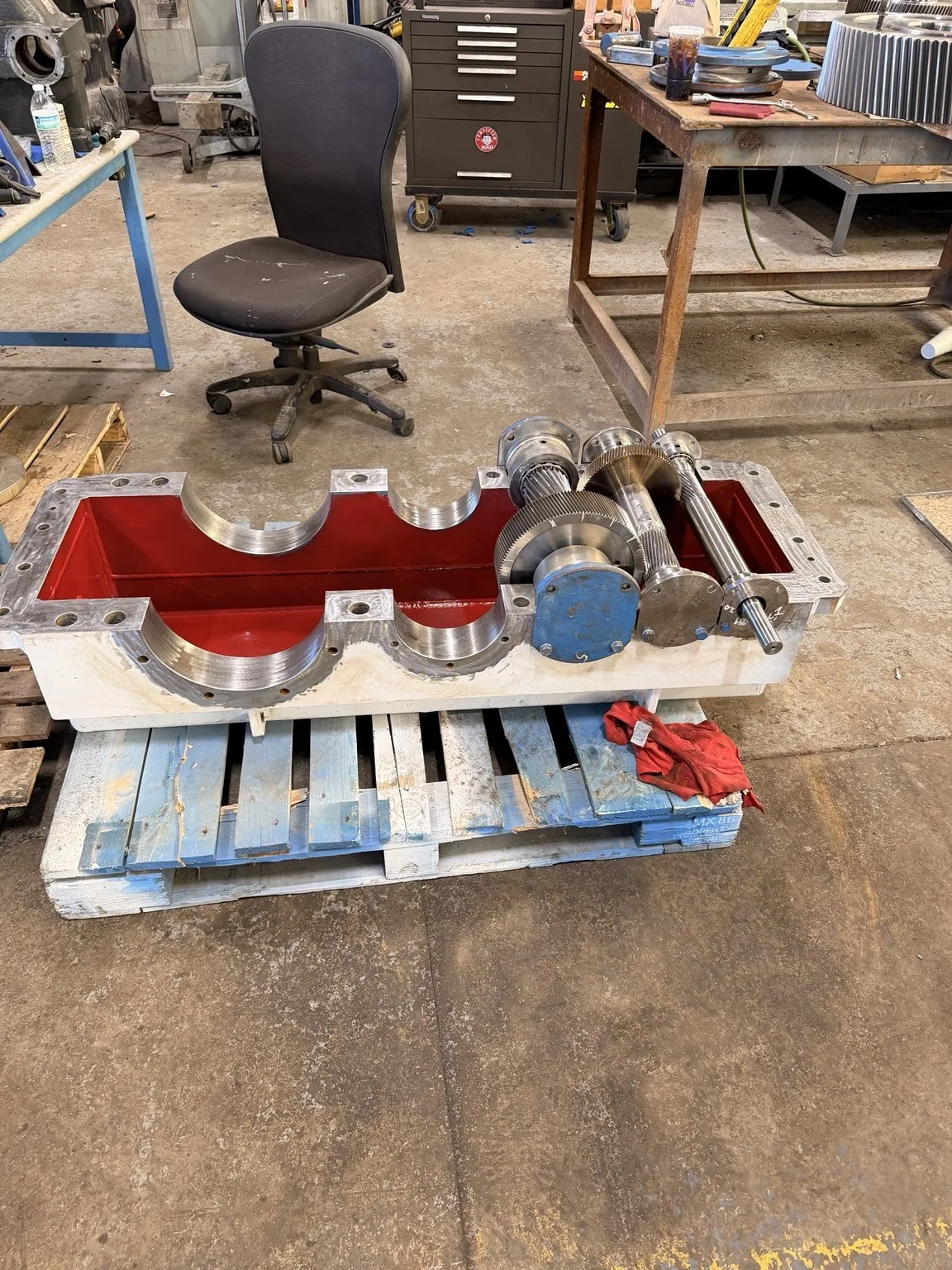
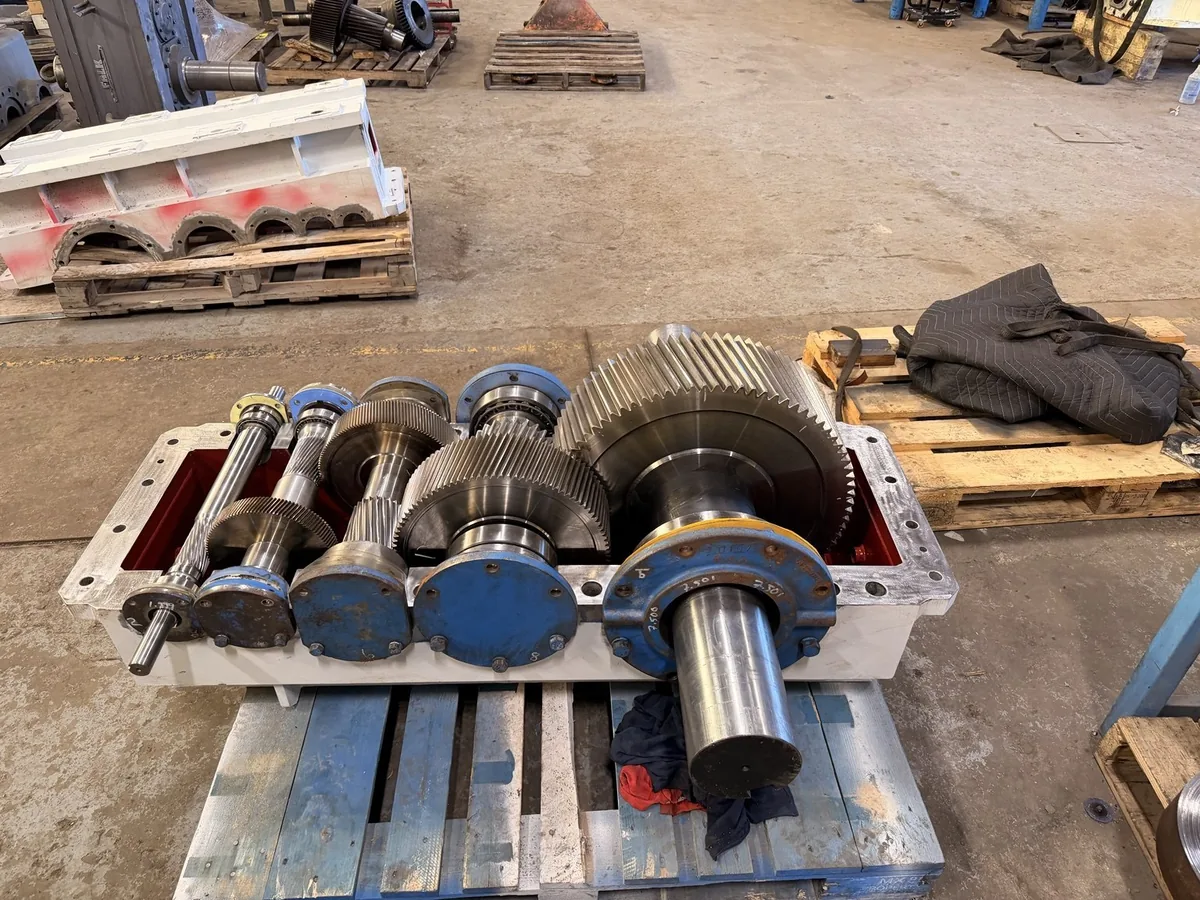
When does a gearbox need rebuilding?
A rebuild is worth evaluating when wear affects several components, contamination has circulated through the assembly, operating condition is uncertain, or repeated problems suggest that isolated repairs are insufficient. A planned outage can also provide an opportunity to assess a critical unit before returning it to a demanding duty.
The decision should follow condition and application, not age alone. A well-maintained older gearbox may have reusable core components, while a newer unit damaged by an overload or lubrication failure may require extensive restoration. Inspection establishes the condition; operating requirements establish whether restoring that condition is worthwhile.
Symptoms that justify a broader assessment
Increasing backlash, persistent leakage, multiple noisy bearings, recurring overheating, and widespread wear debris can point toward a system-level problem. None proves that a rebuild is the only option. Evaluate the symptoms together with the service history, load pattern, lubricant condition, and previous repairs.
An overhaul should also examine the reason earlier work did not solve the problem. If a bearing has been replaced several times, ask whether its seat, lubrication path, loading, or installation condition was evaluated. Repeating the same component replacement without checking its support system can reproduce the same failure.
Define the rebuild's technical acceptance basis
Before the workshop declares parts reusable, identify the source of acceptance requirements. These may include manufacturer instructions, drawings, component specifications, and a documented engineering assessment where original information is unavailable. An unexplained statement that a component is “within tolerance” is incomplete without the relevant tolerance and measurement.
Record the intended ratio, rotation, shaft arrangement, mounting position, lubricant system, and operating duty. If any requirement is changing, separate restoration from redesign. A higher throughput target, altered speed range, or new vertical installation can affect the engineering assessment and should not be hidden inside a standard overhaul order.
Distinguish condition restoration from an upgrade
Restoring fits and replacing worn components aims to return the assembly to an acceptable condition. Increasing torque capacity, changing ratio, or modifying lubrication may be a separate engineering project. Define who approves those changes and which calculations, drawings, tests, and operating instructions must be revised.
Establish what the final report will demonstrate
Agree on the component inspection record, retained-part list, replacement identification, assembly measurements, and test observations. Decide whether specific photographs or inspection certificates are required. The documentation should explain the work actually performed, rather than repeating a generic rebuild checklist that could apply to any gearbox.
Complete disassembly without losing useful evidence
Capture the incoming assembly
Record external condition, identification, accessory configuration, oil observations, and evidence of leakage or movement. Preserve the location of debris and visible damage before cleaning. Note undocumented modifications, unusual spacers, and signs of previous repair so they can be assessed rather than silently copied into the rebuilt unit.
Identify parts and their relationships
Mark and record component positions using a suitable method. Bearings, caps, housings, shims, and gearsets can have location-specific relationships. Maintain traceability through cleaning and inspection. Interchanging apparently similar parts without checking the design can undermine the alignment or adjustment that the original assembly required.
Review the failure sequence
During teardown, distinguish primary damage from the consequences of running afterward. A damaged bearing can shift a shaft and alter tooth contact; fractured teeth can contaminate the oil and damage other surfaces. If the sequence cannot be established confidently, document uncertainty and still address all observed damage.
Inspection of the components that determine rebuild quality
Gears and tooth surfaces
Inspect the working flanks, roots, edges, and related features for wear, cracking, pitting, scuffing, and fracture indications. Assess the distribution of damage across the mesh. A gear with apparently modest surface wear may still need further examination if loading history or visible indications suggest deeper damage.
Measurements may include tooth geometry, runout, bore condition, and features that control mounting and alignment. The required checks depend on the gear type and acceptance basis. Tooth count and outside diameter are insufficient to specify a replacement. Refer to custom gear manufacturing when a new component must be defined.
Shafts, journals, and connections
Examine bearing journals, seal tracks, shoulders, keyways, splines, threads, and coupling seats. Check relevant dimensions and geometry, including runout where required. A shaft can appear intact while a worn seat permits movement that changes alignment or damages a new bearing.
Restoration methods must suit the material, loading, and location. A process acceptable for a seal surface may be inappropriate for a highly loaded bearing journal or critical shaft section. Specify the finished dimensions and inspection requirements, and do not treat a restored surface as acceptable solely because it looks smooth.
Bearings and bearing arrangements
Record bearing identification, orientation, damage, and fit condition. Bearing selection involves more than matching a catalog envelope. Arrangement, internal clearance or preload requirements, load direction, speed, temperature, and lubrication all matter. Changes require a documented suitability assessment rather than an informal substitution.
Inspection should include the support surfaces and lubrication delivery. New bearings cannot compensate for an out-of-round housing bore, a damaged shoulder, or restricted oil supply. In the final scope, connect bearing replacement to the condition of the features that locate and support it.
Housings, covers, and interfaces
Assess bores, split lines, locating features, mounting feet, threads, and structural damage. Geometric relationships matter as much as individual dimensions. Restoring a bore to size is not enough if its position relative to another bore is wrong. Any housing restoration must preserve the required shaft alignment and component location.
Cracks require evaluation of their cause, extent, material, and location. Not every crack is repairable, and a weld is not automatically an acceptable structural restoration. Record the proposed method, any heat effects, finish machining, and inspection needed before deciding whether housing reuse is credible.
Seals, breathers, and lubrication hardware
Check sealing surfaces, vents, passages, pumps, filters, coolers, and associated lines where fitted. Replacing seals while leaving a blocked breather or damaged shaft track can lead to renewed leakage. Contaminated auxiliary circuits can also reintroduce debris into a freshly assembled gearbox unless the approved cleaning or replacement scope includes them.
Restore, replace, or retain: make each decision explicit
A useful rebuild report groups components by disposition and explains the reason. Retained parts should have an acceptance basis. Restored parts should have a defined process and finished requirements. Replaced parts should have suitable identification and specification. Components awaiting a decision should not disappear from the scope merely because assembly is approaching.
When an obsolete part cannot be sourced, evaluate whether it can be accurately specified and manufactured. That may require analysis of an unworn mating part, drawings, materials, and operating duty. Availability of machining equipment alone does not establish that the missing design information has been recovered.
Manage changes after inspection
Unexpected damage can change cost, schedule, and the repair-versus-replacement comparison. Present the finding before proceeding beyond the agreed authorization. The plant should understand whether a change restores the original requirement or introduces a different operating arrangement that needs its own approval.
Reassembly: controlling fits, settings, and cleanliness
Assembly should follow the applicable design information, with components protected from contamination and damage. Confirm the correct orientation and arrangement of bearings, gears, seals, shims, and spacers. Use the prescribed installation methods and fastening requirements. Avoid generic assembly instructions that ignore differences between gearbox designs.
Relevant records can include bearing settings, shaft end movement, backlash, contact assessment, fastener checks, and lubrication configuration. Each value needs its method and acceptance reference. A measured number without a defined location or condition can be difficult to interpret later.
Why contact pattern and backlash are different checks
Backlash describes clearance in the mesh; contact assessment considers how the tooth surfaces engage under the stated checking conditions. One does not replace the other. Acceptable results depend on geometry, assembly, and the manufacturer's requirements. A pattern observed under light checking conditions does not by itself prove full-load behavior.
Clean the complete lubrication path
Where a failure distributed debris, include relevant reservoirs, lines, filters, coolers, and auxiliary equipment in the contamination-control plan. The method depends on the system and component condition. Record what was cleaned, inspected, replaced, or excluded so the installation team knows what remains to be done before oil circulation resumes.
What testing can a rebuild demonstrate?
Static checks can confirm identification, assembly condition, specified movement, lubrication provisions, and other measurable requirements. Running checks can observe noise, vibration, temperature trends, leakage, and operation under the test setup. The actual package must be agreed; the word “rebuilt” does not promise every possible test.
A no-load run and a loaded test answer different questions. State speed, duration, lubricant, load where applied, measurement locations, and acceptance criteria. If the workshop cannot reproduce the plant's operating duty, identify that limitation and plan the remaining site checks. Avoid describing an unloaded run as proof of rated-load performance.
Handover should support installation
Provide relevant instructions for transport condition, storage, lubrication preparation, and commissioning. State whether ports or breathers need configuration for operation. Identify recommendations that the plant must complete, such as correcting foundation movement or verifying an external oil circuit. The rebuild ends with documented condition; reliable service also depends on installation and operation.
Rebuild versus buying a new gearbox
Rebuilding may preserve valuable interfaces and recover serviceable housings, shafts, or gears. It can be attractive for an obsolete but suitable unit whose replacement would require extensive machine changes. These advantages must be balanced against component condition, the reliability of restoration methods, and the availability of a credible acceptance basis.
A new unit may be preferable when damage is extensive, original capacity no longer suits the duty, or technical uncertainty outweighs the benefit of retaining the assembly. Compare total installed cost, lead time, expected duty, maintainability, and remaining risks. There is no universal percentage of replacement price at which every rebuild becomes a good decision.
For a broader purchasing framework, use the repair-or-replacement guide. Keep the commercial comparison connected to the actual inspection findings rather than deciding from age or purchase price alone.
Applications that benefit from a defined overhaul scope
Production reducers, mixer drives, material-handling equipment, and other critical rotating assets can require overhaul planning. Continuous operation, cyclic loading, reversing duty, contamination, and difficult access all influence the scope. The application description should explain these conditions instead of relying only on an industry label.
Specialist arrangements require additional checks. An extruder may have a dedicated thrust system; a planetary unit depends on several interacting load paths; a cooling tower drive operates within a fan system. Their respective service pages explain the extra questions that a generic overhaul specification should not overlook.
Why consider Industrial Gearbox Service for rebuilding?
Industrial Gearbox Service states that its team brings 50 years of experience in industrial gearbox service and repair. This is a company-provided claim. A rebuild discussion should translate that experience into a transparent scope: what can be retained, what must change, and what the final checks will demonstrate.
Ask for confirmation of the equipment and process capabilities required for your unit. Model coverage, dimensional capacity, restoration methods, test facilities, and commercial terms need project-specific confirmation. This guide does not claim certification, original-manufacturer authorization, or a standard warranty period.
Use the repair brief to prepare equipment details and intended duty. In the current preview, the brief is downloaded locally and is not submitted. Include available drawings and previous rebuild reports so the evaluation starts with the best existing information.
Compare rebuild proposals by technical coverage
Place competing proposals beside the same equipment brief and compare their boundaries. One may include dimensional inspection of housings and shafts while another assumes those parts are serviceable. One may include external lubrication-system work while another covers only the gearbox. A lower price may represent a narrower scope rather than a more efficient route to the same result.
Ask how findings will be reported before parts are discarded or restored. Photographs and measurements made during teardown may be the best opportunity to understand the failure. Agree which removed components must be retained for customer review and how long they will be held. If destructive examination is proposed, identify the approval required because it may consume evidence or a potentially reusable sample.
Review acceptance language with the same care as component lists. “Tested” should resolve into a described setup and recorded checks. “Reconditioned” should resolve into a component disposition and finished requirement. “Ready to install” should explain shipping condition, lubricant status, and actions required before operation.
A clear comparison also identifies who owns unresolved engineering questions. If the manufacturer no longer supports the unit, ask how tolerances and component specifications will be established. The decision should weigh that technical confidence alongside price and schedule. A rebuild proposal is most useful when the customer can understand both the restoration work and the limits of what it will prove.
Frequently asked questions
Does rebuilding mean every internal part is replaced?
No. Rebuilding describes an overhaul process. The approved scope should identify which parts are retained, restored, or replaced and the acceptance basis for each decision.
Can a rebuild restore an obsolete gearbox?
Possibly, if its geometry, materials, loading, and component requirements can be established and suitable parts or restoration methods are available. Obsolescence alone neither proves nor rules out rebuild feasibility.
What is the difference between rebuilding and remanufacturing?
Suppliers use these terms differently. Compare the written work scope, component disposition, acceptance requirements, and test evidence rather than assuming a particular standard from either label.
Why are bearing seats measured during an overhaul?
Their dimensions and geometry affect bearing support and location. Installing a new bearing in a damaged seat can leave movement, alignment, or fit problems unresolved.
Can worn gear teeth simply be polished and reused?
Surface treatment is not a universal remedy. The damage type, remaining geometry, material condition, and loading determine whether reuse is acceptable. Removing visible marks does not establish structural suitability.
Are original shims always reused?
Not automatically. Component changes and restored dimensions can affect required adjustments. Use the design's assembly method and measured requirements rather than reproducing an old shim stack without verification.
What does an acceptable tooth contact pattern prove?
It provides evidence about engagement under the checking conditions. Interpretation depends on gear design and method. It does not independently establish all operating-load behavior or replace other assembly measurements.
Can a gearbox housing be line-bored during rebuilding?
Where technically suitable, machining may restore bearing locations. The plan must control size, alignment, spacing, material condition, and final inspection. Feasibility depends on the particular housing and damage.
Should external oil coolers be included in the rebuild scope?
Consider them when contamination or oil-supply problems are involved. State whether the cooler and circuit will be cleaned, inspected, replaced, or handled separately before recommissioning.
Does rebuilding automatically extend the rated service life?
No fixed life extension follows from the service name. Outcome depends on component condition, scope, operating duty, installation, and maintenance. Avoid assigning a life promise without an established basis.
Can a rebuilt unit run at a higher torque?
Not merely because it has been rebuilt. Higher duty requires engineering assessment of the complete gearbox and connected system. Restoration and uprating are different decisions.
What if the original drawing is unavailable?
The provider must establish a documented acceptance basis using available records, measurements, component data, and engineering assessment. Unknown requirements should remain explicit rather than being replaced with arbitrary tolerances.
Is crack testing required on every part?
The appropriate method and extent depend on the component, material, damage indications, service history, and agreed requirements. A generic claim that everything was tested is less useful than a specific inspection record.
Why might a rebuild require new shafts?
Cracking, unsuitable journal condition, distorted geometry, or damaged critical connections can make reuse or restoration unacceptable. The decision should be tied to measurements and the proposed operating duty.
How should retained components be documented?
Identify the part, relevant inspection findings, measurements where applicable, and the basis for acceptance. This makes reuse a traceable decision rather than an undocumented assumption.
What should a rebuild test report state?
It should state the unit, setup, speed, duration, load if applied, measurements, acceptance requirements, results, and limitations. The report should describe the actual test rather than imply a broader one.
Can rebuilding solve a recurring process overload?
Only if the overload cause is addressed or an approved design change accommodates the duty. Replacing damaged parts does not correct an unsuitable process load by itself.
How should a rebuilt spare be stored?
Follow equipment-specific preservation and storage instructions. Record storage condition and any required inspections. Preparation for long-term storage may differ from preparation for immediate installation.
Which maintenance records help a rebuilding evaluation?
Previous repair reports, lubricant history, vibration trends, alarm records, load changes, and alignment data can all help. Include uncertainties and distinguish documented events from recollections.
What is the first practical step in commissioning a rebuild?
Confirm the returned unit's identity, scope, shipping condition, and installation instructions before energizing it. Complete the plant's approved installation and startup process, including unresolved external corrections.