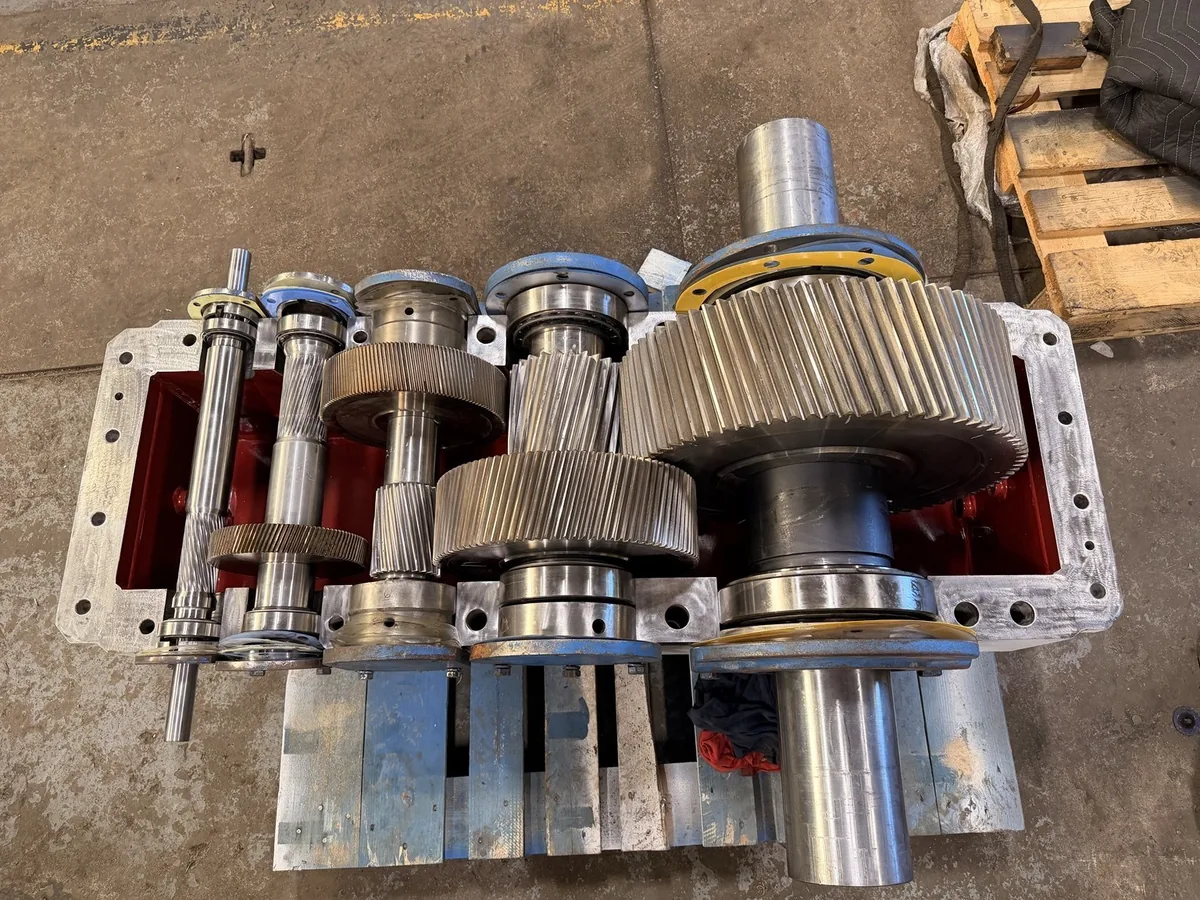
Planetary gearbox repair requires inspection of the complete gearset and its supporting structure. The sun gear, planet gears, ring gear, carrier, planet pins, bearings, and connected shafts work as an assembly. Damage to one part can change alignment or load distribution elsewhere, so replacing a visibly damaged planet alone may leave the initiating problem unresolved.
Planetary reducers achieve compact torque transmission through several interacting meshes. The exact arrangement varies: different members can be fixed, driven, or used as the output, and multiple stages may be combined. Identify the model, stage arrangement, and application before interpreting movement, specifying parts, or defining an assembly procedure.
How a planetary arrangement changes the repair assessment
A conventional description includes a central sun, surrounding planets, an internal ring gear, and a carrier supporting the planets. That description helps identify components, but it does not establish the actual power path or all constraints of a particular gearbox. Drawings and manufacturer information are needed to understand the installed design.
The condition of supporting features is especially important. Pin position, carrier geometry, bearing support, ring location, and shaft relationships can influence how the gearset engages. The number of planets does not guarantee perfectly equal loading. A repair must assess the arrangement that controls those relationships, not only count damaged teeth.
Identify each stage and its interfaces
Record the input and output members, stage order, rotation relationships, and any external brake, backstop, or torque reaction arrangement. A multi-stage reducer may contain different bearing and gear configurations. Preserve these distinctions in the inspection report so findings can be assigned to the correct location.
Distinguish industrial duty from positioning duty
A heavy process reducer and a precision positioning gearbox can have different requirements for backlash, rigidity, speed, and acceptance testing. Do not transfer a tolerance from one category to the other. Explain what the driven equipment needs the gearbox to do after repair, including reversals and transient loads.
Common planetary gearbox failure symptoms
Increasing lost motion at the output
Lost motion can accumulate through gear meshes, splines, keys, bearings, and connections. It may also include elastic movement under the checking load. The significance of a measured value depends on the method, position, direction, and design requirement. An output movement check does not automatically identify which internal component is worn.
Uneven wear among planet gears
Different wear patterns can suggest unequal operating conditions within the assembly, but the cause needs investigation. Carrier and pin geometry, bearing condition, component variation, lubrication, and loading can all be relevant. Document each planet's original position and compare findings across the set rather than treating each part as an unrelated failure.
Noise that changes with load or rotation
Planetary vibration and sound can be complex because several meshes and moving relationships contribute. A simple frequency assumption based only on motor speed may be misleading. A qualified analyst needs the actual kinematic arrangement and tooth counts where available, together with speed and load records.
Heat, leakage, and lubricant debris
Temperature rise, oil loss, and wear debris can signal lubrication or mechanical distress. Record sensor location, mounting orientation, lubricant identity, and operating duty. The symptoms do not independently establish which stage is damaged. Inspection should follow the contamination path and assess the supporting oil system where fitted.
Output movement or mounting distress
Unexpected shaft movement, loose reaction hardware, or damage around the mounting interface may involve bearings, carrier supports, connections, or the driven machine. The relevant forces depend on the application. Physical checks require the equipment's approved isolation and support methods, particularly where a load could move when the drive is disconnected.
Diagnosis before opening the unit
Prepare the manufacturer, model, serial number, ratio, mounting position, and available stage drawings. Describe the application, speed range, reversing duty, load changes, and previous repairs. Record whether the event followed a jam, impact, brake problem, lubrication alarm, or change in operating conditions.
A useful diagnosis combines existing vibration and temperature trends, lubricant information, measured external movement, and internal inspection. Each source has limitations. Debris can indicate wear without identifying the originating stage; a movement reading can show a system change without locating the clearance. Avoid turning an incomplete observation into a confident component diagnosis.
Review lubrication configuration
Mounting position and gear-unit design affect lubrication requirements. Obtain the exact instructions for the model rather than using a generic fill volume. The SEW-EURODRIVE planetary gearmotor instructions illustrate model-specific mounting and lubrication arrangements; their values should not be transferred to unrelated reducers.
Assess external loading and restraint
Identify radial, axial, torque reaction, and transient loads relevant to the installation. Check whether the driven system or mounting has changed. An otherwise acceptable internal repair may not solve repeated damage caused by an unsuitable external load or distorted mounting condition. Assign those questions to the responsible machine engineering team.
Planetary gearbox teardown and inspection
Preserve positional identity
Record the position and orientation of planet gears, pins, bearings, carriers, ring gears, shims, and spacers. Maintain stage identity through cleaning and measurement. Some parts may have design-specific assembly relationships or matching requirements. Do not exchange locations because two components appear visually identical.
Inspect the sun gear and its connection
Examine tooth flanks, roots, bore or integral shaft features, splines, and locating surfaces. Assess the connection that transmits input or intermediate-stage torque. Wear in a spline or support feature can influence behavior even when the visible sun-gear teeth are not the most damaged surfaces.
Compare all planets within the stage
Record tooth condition, bearing condition, bores, and relevant geometry for each planet. Compare the pattern and severity of findings. A single badly damaged planet may be the most visible result of a broader carrier, pin, or load-distribution issue. The scope should explain why other components are acceptable to retain.
Examine planet pins and bearings
Inspect journals, fits, retention, lubrication features, and signs of movement or distortion. The bearing arrangement determines the applicable checks. A new bearing installed on a damaged pin does not restore proper support. Evaluate the pin's relationship with the carrier as well as its individual dimensions.
Assess carrier geometry and integrity
The carrier locates the planets and transfers load through its designed connections. Relevant checks may include pin-location relationships, bores, support surfaces, cracking indications, and deformation. Restoration must preserve the required geometry and strength. A locally repaired feature is not sufficient evidence that the complete carrier remains suitable.
Inspect ring gear and housing support
An internal ring may be a separate component or integrated with another structure. Assess teeth, locating features, retention, and the housing arrangement. Damage or movement in the support can affect the meshes. The manufacturing and restoration options depend on material, geometry, design, and the extent of damage.
Follow debris into other stages and circuits
When damaged material circulates, inspect other exposed bearings and meshes and assess auxiliary lubrication equipment where applicable. Do not assume an undamaged-looking stage is unaffected solely because the initial noise was attributed elsewhere. Define how contamination will be removed and how excluded equipment will be handled before restart.
Repair decisions for planetary components
Reuse, restoration, and replacement need a documented acceptance basis. Some damaged pins, shafts, housings, or connection surfaces may be restorable through a justified process. Other damage requires replacement. The appropriate method depends on the material, loading, dimensional relationships, and inspection requirements of the particular component.
If a sun, planet, or ring gear must be manufactured, recover the complete functional definition. Tooth geometry, material, treatment, locating features, and the mating relationship matter. Custom gear manufacturing should be treated as an engineering and production scope within the repair, not as a promise that every damaged sample can be copied.
Can one planet be replaced separately?
There is no universal answer. Review matching requirements, the condition and geometry of the remaining planets, bearing arrangements, and the cause of unequal damage. The provider should explain the technical basis for individual replacement or replacement of a set. Lowest component cost alone is not that basis.
When does the job become a rebuild?
Widespread wear, contaminated stages, damaged support features, or uncertain assembly condition can justify a complete gearbox rebuild. A broader scope can be necessary even if only one component initially stopped the machine. Define the work by findings rather than by a marketing label.
Reassembly and verification
Reassemble using the design-specific stage relationships, bearing settings, fits, fastening requirements, and lubrication configuration. Where timing or assembly indexing requirements apply, verify them from the correct instructions. Generic planetary assembly rules should not replace the actual manufacturer's or approved engineering requirements.
Measurements need a defined method. An output backlash check should state the restraint and applied conditions. A bearing movement check should identify the location and setup. Without these details, two technicians may produce different values without either measurement describing the same condition.
Verify the full power path
Static inspection should confirm the intended arrangement, connections, lubrication provisions, and other specified assembly requirements. Running checks should describe speed, direction, duration, load if applied, and recorded observations. Multi-stage behavior should be evaluated within the limits of the available test setup.
Recognize the limits of an unloaded test
An unloaded run does not establish full torque capacity or demonstrate load distribution at production duty. If loaded testing or a particular performance check is required, establish the setup and acceptance criteria before repair authorization. The handover should state what remains to be verified during installation and controlled commissioning.
Repair versus replacement for a planetary reducer
Repair may preserve a specialized mounting interface and recover valuable core components. It is worth evaluating when geometry can be restored, suitable parts are available, and the unit remains appropriate for the duty. A replacement should be compared against the whole installed arrangement, including supports, connections, brakes, controls, and driven-equipment interfaces.
Replacement may be preferable when carrier or ring damage is extensive, multiple stages require uncertain reconstruction, or the original gearbox no longer meets the application. Consider technical confidence, time to commissioned service, total cost, and maintainability. A ratio match alone does not establish equivalent performance or compatibility.
A decision example
If inspection finds an isolated damaged seal surface with acceptable bearings, gears, and support geometry, a limited restoration may be reasonable. If it finds distorted carrier features, several damaged planets, and a changed load requirement, a broader rebuild or replacement comparison is warranted. These illustrate assessment logic, not actual customer results.
Industrial planetary applications
Planetary drives can appear in material processing, mixing, conveying, and other applications requiring compact torque transmission. Some operate in lifting or other load-holding systems with additional requirements. Identify the actual function and applicable safeguards before defining removal or repair work. This page does not establish suitability for every safety-critical application.
The industry alone does not determine the inspection scope. Reversing duty, shock loading, output forces, mounting restraint, contamination, and speed range can be more informative. Supply those details and the original equipment records where available. For a stopped production asset, use the emergency repair resource to organize the outage decision.
Why consider Industrial Gearbox Service?
Industrial Gearbox Service states that its team brings 50 years of experience in industrial gearbox service and repair. This is a company-provided claim. For planetary work, the meaningful questions concern how the provider will evaluate the entire stage, preserve component identity, inspect carrier and pin relationships, and justify parts reuse.
Confirm model coverage, dimensional capacity, available inspection methods, restoration routes, and the actual test scope. This guide does not claim universal planetary capability, manufacturer authorization, or a fixed warranty. The agreement should identify which parts of the gearbox and connected system are included.
Prepare the repair brief with identification, stage drawings if available, symptom history, duty, and required return date. The preview downloads the brief locally and does not send it. Include previous repair findings, especially if the same planet position or support feature has shown repeated damage.
Use a component-position record to support the repair decision
A position record can identify each stage, planet location, bearing arrangement, and observed damage without implying that every unit uses the same layout. Pair photographs with the labels used in the inspection report. If one planet shows a different pattern from its neighbors, the team can then relate that finding to its original pin and carrier position.
Keep measured results connected to the same identification system. A list of bore dimensions is less useful if nobody can determine which location each value describes. Record the instrument or method where relevant and the acceptance reference. This helps reviewers distinguish a component that is dimensionally acceptable from one that merely appears similar to the others.
Use the record to explain the proposed scope. If the provider recommends retaining some components, ask how their condition and relationship to replacements were assessed. If a complete set is recommended, ask which design or condition factors support that choice. The objective is an understandable technical decision, not an automatic preference for either minimum replacement or maximum replacement.
Retain the record with the final assembly and test information. If a future inspection finds another abnormal pattern, the plant will have a meaningful comparison instead of relying on memory. Repeated damage at the same location can then be investigated with a traceable history.
Frequently asked questions
What parts make up a typical planetary gearset?
A common arrangement has a sun gear, planet gears, an internal ring, and a carrier. The actual input, output, fixed member, bearing arrangement, and number of stages depend on the design.
Why can planet gears wear unevenly?
Differences in support geometry, bearing condition, lubrication, component condition, or loading may contribute. Preserve positional identity and compare the complete stage before identifying a cause.
Does more output backlash always mean worn planet teeth?
No. Movement can come from several meshes, connections, bearings, or elastic effects. Interpretation requires the specified checking method and the design's acceptance requirements.
Can a single damaged planet be replaced?
Possibly, subject to the design's matching requirements and the condition of the remaining stage. The replacement decision should address geometry, bearings, and the reason one component was damaged.
Why is carrier inspection important?
The carrier locates and supports planet assemblies. Damaged or distorted features can affect their relationships, so replacing gears alone may not restore an acceptable stage.
Can planet pins be restored instead of replaced?
Some damage may be restorable under an approved technical method. Material, loading, fit, geometry, lubrication features, and final inspection determine feasibility for the particular pin.
Is the ring gear always a removable part?
No. Designs differ, and the ring may be integrated with another structure. Its construction and support arrangement affect inspection, manufacturing, and replacement options.
Should all stages be inspected after a gear fracture?
Assess the contamination path and interacting components. Debris or secondary loading may affect stages beyond the visibly failed one. Define the inspection scope from the design and findings.
Can a planetary gearbox be filled with oil by a generic volume?
Use the model's specified method and mounting requirements. A generic volume can be inappropriate for the arrangement, accessories, or installation orientation.
Why does reversing duty matter to a planetary repair?
Reversals change the operating load pattern and can expose movement in meshes and connections. Include actual duty and control behavior when evaluating component condition and repair suitability.
Can planetary gear teeth be reverse engineered from photographs?
Photographs can support identification but do not establish a production specification. Detailed measurements, material requirements, mating information, and design review are generally needed for custom manufacture.
Does a no-load run prove equal load sharing?
No. It does not reproduce rated torque or establish distribution under the plant's duty. Any specific load-sharing assessment needs an appropriate method and defined test conditions.
What information helps vibration analysis of a planetary reducer?
Provide stage arrangement, tooth counts where available, speeds, operating member relationships, load, and sensor locations. Planetary kinematics can make simple motor-speed assumptions inadequate.
Can a housing repair change planetary alignment?
Yes, if critical locating relationships are altered. A restoration plan must control relevant geometry and inspect the finished result, not merely restore an individual bore diameter.
Are planet components interchangeable between positions?
Do not assume so. Preserve identity during teardown and check the design's arrangement or matching requirements before changing locations or substituting parts.
What if the gearbox is part of a load-holding machine?
The scope must account for the connected load, brake or restraint system, isolation, and application-specific requirements. Qualified personnel should define removal and return-to-service procedures for the complete machine.
Can repair change the reducer's output torque rating?
A rating change requires engineering assessment. Restoring worn components does not automatically establish a higher allowable torque or a different duty classification.
What should a planetary inspection report show?
Identify stages and component positions, describe gear and bearing findings, record relevant support measurements, and explain reuse or replacement decisions. Separate confirmed causes from unresolved hypotheses.
When should replacement be favored over planetary rebuilding?
Consider replacement when structural or multi-stage damage, unavailable specifications, unsuitable duty, or uncertain restoration makes rebuilding less credible. Compare complete installed alternatives rather than component prices alone.
What should be monitored after the repaired unit is installed?
Record agreed baseline behavior under known speed and load, including relevant temperature, vibration, leakage, and lubricant observations. Follow the approved commissioning and monitoring plan for that machine.