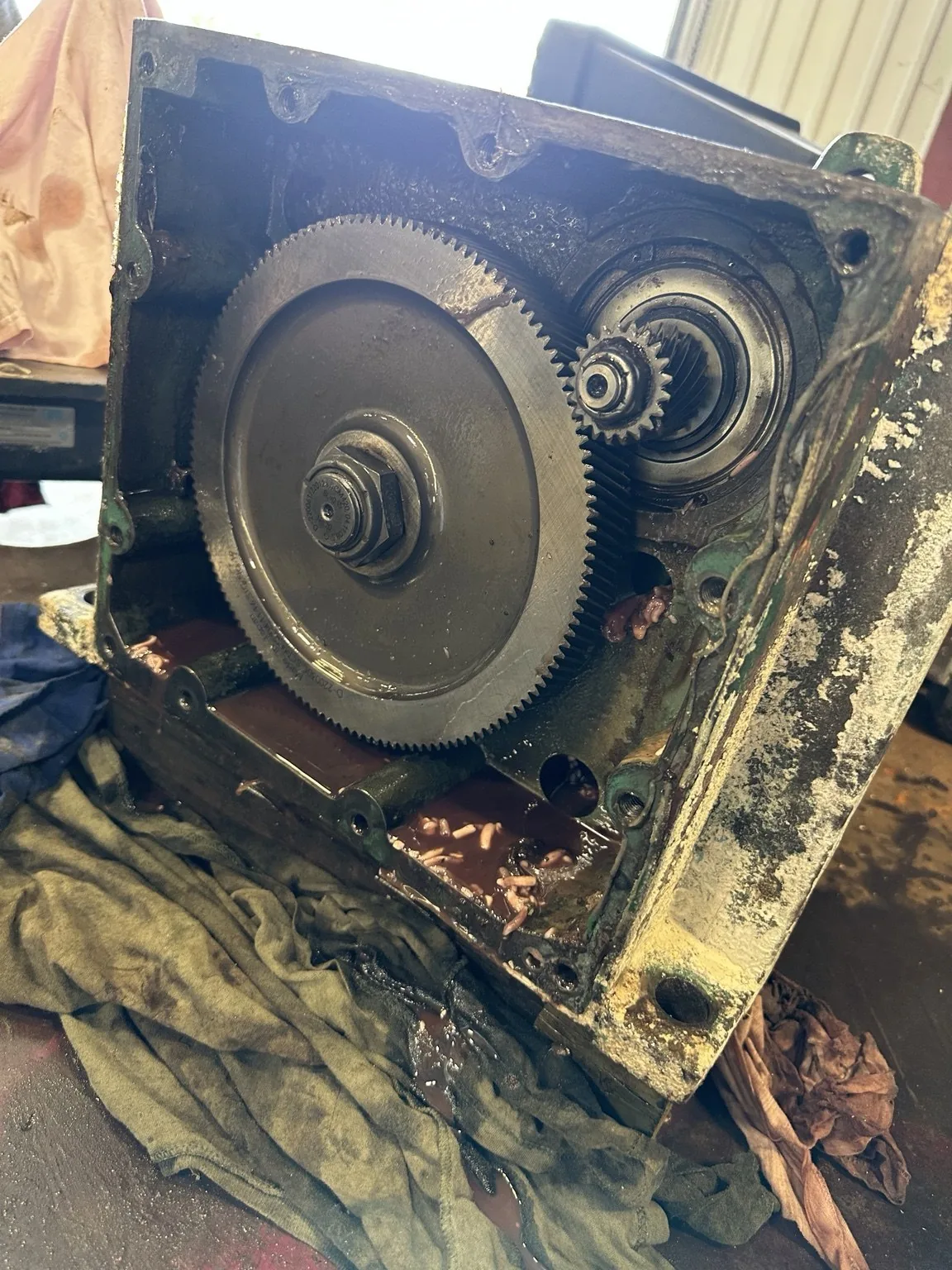
Industrial gearbox failure analysis connects the damaged component with the conditions that caused it to fail. A replacement bearing or gear may address the immediate damage, but the repair decision is stronger when the inspection also considers the machine's operating history. This guide explains what to record, what an investigation should distinguish, and how to turn findings into an actionable repair scope.
Start with a failure timeline
Write down the last period of normal operation, the first unusual observation, and the point when production stopped. Separate things that were measured from things that were estimated. “Temperature increased after the speed change” is a more useful starting point than “the gearbox overheated,” particularly when the actual temperature and normal operating range are available.
Include recent changes to the load, motor, coupling, lubricant, maintenance schedule, or surrounding process. A timeline does not prove a cause. It helps the person inspecting the unit decide which possibilities need evidence.
Organize symptoms without guessing the diagnosis
| Observation | Useful supporting information |
|---|---|
| New noise | When it occurs, speed, load, and whether it changes during the cycle |
| Temperature change | Measurement location, operating conditions, and previous readings |
| Visible leakage | Photographs before cleaning and recent service history |
| Repeated component damage | Previous inspection reports, replaced parts, and time in service |
Preserve the history
Keep existing maintenance records, oil-analysis reports, monitoring trends, and photographs together under the equipment identification. Ask the receiving specialist what evidence to preserve before cleaning or dismantling the unit. Do not operate damaged machinery simply to obtain a recording; observations should come from existing records or an appropriately controlled assessment.
Separate damage from root cause
An inspection can document a damaged surface without yet establishing why it became damaged. A useful report identifies the observed condition, the possible contributing factors, and the checks that support or challenge each explanation. When evidence is incomplete, the report should say so.
For a repeat failure, the investigation should extend to relevant installation and operating conditions. Repairing the same component again without reviewing the earlier findings makes it difficult to know whether the next repair addresses the recurring problem.
Turn findings into repair decisions
Ask for a clear connection between each proposed repair and the condition it addresses. The quotation should distinguish work needed on the gearbox from actions assigned to the installation or maintenance team. Record who will close each action before startup.
Questions to include in your inquiry
- Which observations are confirmed by inspection?
- What further measurements are needed?
- Does the proposed work address the failure mechanism or only its visible damage?
- What must be checked on the connected equipment?
What if the cause cannot be confirmed?
Acknowledge the remaining uncertainty and agree what additional investigation is worthwhile. A qualified conclusion is more useful than a confident guess. Keep the final report with the equipment history so future operating observations can be compared with the repair findings.
Build an evidence file that someone else can understand
A useful investigation file should make sense to an engineer who has never visited your plant. Start with the equipment identification and a short explanation of what the drive does. State whether the gearbox runs continuously, starts frequently, changes direction, or experiences a changing process load. Include available operating records rather than relying entirely on recollection after a breakdown.
Label each photograph with its date, the equipment number, and what it shows. A close photograph of a damaged surface is more useful when accompanied by a wider view showing its location in the assembly. Keep the original image files so details are not lost through repeated screenshots or messaging compression. Identify photographs taken before removal separately from those taken after dismantling.
Keep observations and interpretations in separate columns
For example, “oil found beneath the output end on Monday” is an observation. “Output seal failure caused by pressure” is an interpretation that still requires assessment. Recording both is reasonable, provided they are labeled correctly. This distinction prevents an early assumption from becoming the accepted explanation before anyone has inspected the equipment.
Assign one person to maintain the file as new information arrives. If the operator, maintenance technician, and contractor provide different accounts, retain the differences and clarify them. An honest record of uncertainty gives the investigation a better foundation than a polished account that hides conflicting details.
Read an inspection report beyond the photographs
Photographs show condition, but a repair recommendation should explain why the condition matters. Ask which components were accessible, which were dismantled, and which areas remain unevaluated. A report based on an external inspection should not be treated as a complete internal condition assessment. The inspection boundaries should be understandable to the person authorizing the work.
Measurements need context. A number is difficult to interpret without identifying what was measured, the applicable requirement, and the conclusion drawn from the comparison. Where original specifications are unavailable, ask how the proposed acceptance criteria will be established. Do not substitute a generic tolerance from another gearbox for a requirement specific to the unit being assessed.
Look for a clear chain of reasoning
A useful finding connects the evidence, its significance, and a recommended next action. If a report describes damage to several components, ask whether the investigator can distinguish the likely initiating damage from damage that developed afterward. Severe breakdowns can obscure that sequence, so a report may reasonably offer several possibilities rather than a single proven cause.
The level of investigation should suit the decision. An isolated, well-understood repair may not require extensive laboratory work. A repeated interruption with expensive consequences may justify additional specialist analysis. Agree what question any extra inspection or test is intended to answer before approving it.
Investigate recurring problems across the complete drive
When the same unit returns for another repair, compare the events as separate cases. Note the operating hours between incidents, what changed during each repair, and whether the symptoms were actually the same. Two stoppages described as “bearing problems” may involve different locations or different damage patterns. A shared label does not prove a shared cause.
Bring together the gearbox report and relevant installation records. The maintenance team may hold information about the base, coupling, driven machine, or previous alignment work that the workshop has never received. The workshop may hold component findings that the plant has not seen. Combining those records helps identify questions that neither party can resolve alone.
Assign ownership to corrective actions
Separate workshop actions from site actions. Replacing a component may belong to the repair scope, while reviewing an operating change belongs to the plant. Name the responsible person and the evidence needed to close each action. Otherwise, the equipment can return to service while an important recommendation remains an unassigned sentence in a report.
Keep the final action list short enough to manage but specific enough to verify. “Check the installation” is less useful than identifying the installation record or assessment required. The purpose is to establish what must be resolved, not to prescribe an unsupported repair procedure from a general website.
Use operating data carefully
Existing temperature, vibration, and lubricant records can support an investigation, but the conditions under which they were collected matter. Record the measurement location, equipment state, load, and date when known. A reading taken during an unusual production cycle should not automatically be compared with a reading taken under a different duty as if they were equivalent.
If monitoring data are missing, state that plainly. Do not reconstruct precise values from memory or use an unrelated machine's readings as a substitute for the failed unit's history. Similar machines can provide context, but differences in installation and operation must remain visible in the analysis.
After the repair, agree how initial operating observations will be recorded by the responsible team. Those records can become a reference for future maintenance. They do not establish a universal safe operating threshold, and they should be interpreted alongside the equipment instructions and the requirements of the application.
An example of a better failure inquiry
Consider a hypothetical conveyor drive that stopped twice during the same production season. A weak inquiry says only that the gearbox failed again. A stronger inquiry identifies the two incident dates, the component replaced after the first incident, the time in service afterward, and the available inspection reports. It also records whether the conveyor duty or installation changed between events.
The stronger inquiry does not claim to know the answer. It gives the investigator a defined comparison to make. If the second report identifies a different damaged area, the discussion can address that difference. If both reports document the same condition, the investigation can focus on what remained unchanged. This is an illustrative planning example, not a claim about a completed customer project.
Prepare a question-led review
Before reviewing the report, write down the decisions the investigation must support. You may need to know whether the damage is limited to one area, whether additional evaluation is justified, or whether a recommendation must be completed at the plant before restart. Give each question a place in the meeting notes and record whether it has been answered, remains open, or falls outside the agreed scope.
Invite the people who can supply the missing evidence. A maintenance record may explain an earlier intervention, while an operator may clarify the sequence of events. Avoid turning the meeting into a search for someone to blame. The practical outcome is an agreed account of what is known and a manageable list of next actions. Record the basis for any conclusion so a future reviewer can understand it without having attended the discussion.
Gearbox failure analysis: frequently asked questions
Can you diagnose a gearbox failure from a photograph?
A photograph can help identify visible damage and guide an initial conversation, but it usually cannot establish the complete failure mechanism. Internal condition, measurements, and operating history may be needed. Send clear images with the equipment identification and symptom timeline, and treat any initial response as preliminary until the necessary assessment is complete.
Does a failed bearing prove the bearing itself was defective?
No. The damaged bearing is evidence of a condition that needs assessment, not automatic proof of a manufacturing defect. The investigation may need to consider the bearing's installation and operating environment as well as the component. A defensible conclusion should identify the evidence supporting it and acknowledge any information that is unavailable.
Should we clean the damaged parts before sending them?
Ask the investigating specialist first. Cleaning or altering a component can remove information that may be relevant to the assessment. Explain the condition of the parts and request preparation instructions. Also tell the specialist about any cleaning, handling, or dismantling that has already occurred so the available evidence can be interpreted appropriately.
What should operators write down after an unexpected stop?
Record what was observed, when it happened, the operating state, and any recent process change. Include existing alarms or trend records if available. Avoid asking operators to guess the internal defect. Their direct account of the event is valuable precisely because it describes what happened before the unit was removed or disturbed.
Is oil analysis enough to identify the cause?
An oil-analysis report can contribute useful evidence, but it is one part of the equipment history. Its significance depends on the sample context and other findings. Provide the complete report, sample date, and available lubricant records rather than extracting a single result and treating it as a complete diagnosis.
Can the exact root cause always be proven?
No. A destructive failure, missing records, or prior cleaning may limit what can be established. The report should distinguish confirmed findings, probable explanations, and unresolved possibilities. That does not make the investigation pointless: it can still define necessary repairs and identify sensible follow-up actions without overstating certainty.
How long does an investigation take?
The duration depends on access to the unit, the inspection scope, and whether additional specialist work is needed. Ask for the expected stages and decision points instead of assuming a standard completion time. A preliminary condition report and a completed causal investigation are different deliverables and may become available at different times.
What records should we keep after the investigation?
Keep the original observations, photographs, inspection findings, approved repair scope, and completed action list under the asset identification. Retain any qualifications or unresolved questions in the final report. Future maintenance teams need to understand both what was established and what remained uncertain when the equipment returned to service.
Will replacing the damaged gears prevent another failure?
Replacement addresses the specified damaged components, but recurrence depends on whether relevant contributing conditions have also been addressed. Ask how the repair proposal relates to the inspection findings and what actions remain outside the workshop. Avoid treating a parts list alone as evidence that the complete problem has been resolved.
How should we start a failure-analysis inquiry?
Prepare the nameplate details, application description, incident timeline, and any earlier repair reports. Identify the decision you need help with, such as understanding a repeated stoppage or defining a repair scope. Clear questions help establish an appropriate evaluation rather than paying for an undefined investigation with no agreed outcome.
Prepare your equipment details
Bring your gearbox identification and project notes together before discussing the next step.
Create a repair brief ↗